
Arduino-Based Solar Panel Cleaning Robot: Design, Implementation, and Comprehensive Analysis
With the global popularity of solar power, the issue of cleaning photovoltaic panels has become increasingly prominent. Contaminants such as dust, bird droppings, and snow can significantly reduce the electricity generation efficiency of the panels. Regular manual cleaning is costly, poses safety risks, and is inefficient. In this context, automated and intelligent cleaning solutions have emerged. Among them, solar panel cleaning robots developed on the open-source hardware platform Arduino have become popular in research and DIY fields due to their controllable cost, high flexibility, and ease of customization. This paper will delve into the core design, working principles, advantages, and limitations of such robots, as well as their future development prospects.
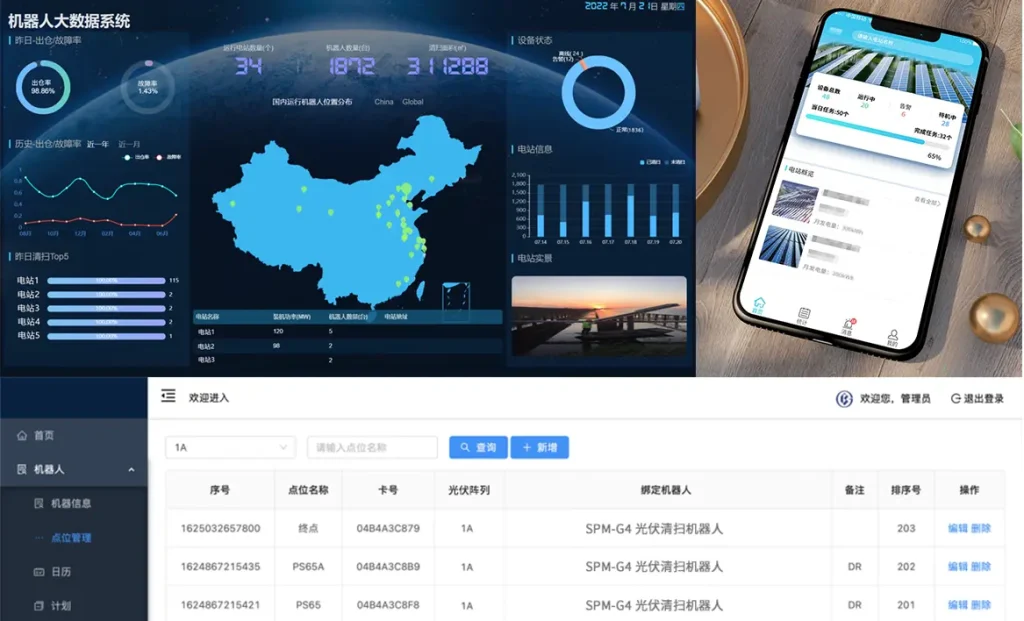
1. Core System Design and Hardware Composition
A typical Arduino-based cleaning robot is an electromechanical system that integrates mobility, cleaning, perception, and control functions. Its hardware architecture usually revolves around a main control board such as Arduino Uno or Mega, consisting of the following modules:
- Mobility and Adhesion Module: This is key for the robot to operate on inclined or even vertical solar panels. It typically uses a wheeled or tracked structure, coupled with a vacuum pump or magnetic attachment device (suitable for framed tempered glass panels) to generate sufficient adhesion and prevent the robot from slipping. Motor drives rely on motor driver modules such as L298N or TB6612FNG, with speed and direction controlled by PWM signals from the Arduino.
- Cleaning Execution Module: The core cleaning action is usually performed by rotating brushes (such as nylon or sponge rollers), driven by an independent DC motor. An integrated water supply system may include a small pump, water tank, and nozzle for spraying clean water or cleaning solution before scrubbing to enhance dirt removal effectiveness.
- Environmental Perception and Navigation Module: To achieve automation, the robot needs to perceive its status and environment. Common sensors include:
- Infrared or Ultrasonic Sensors: Installed around the robot to detect the edges of the solar panels, enabling automatic steering and preventing falls.
- Dust Sensors: Used to detect the cleanliness of the panels for on-demand cleaning.
- Inertial Measurement Unit (IMU): Monitors the robot’s posture to ensure stable operation on inclined surfaces.
- Encoders: Installed on motors to measure travel distance, facilitating path planning and precise position control.
- Energy and Communication Module: The robot can be powered by a lithium battery or designed to draw small amounts of energy from the solar panels themselves. For communication, Bluetooth (such as the HC-05 module) or Wi-Fi (such as the ESP8266) modules can be added to receive start commands or upload operational status to a mobile app or the cloud.
2. Workflow and Control Logic
The robot’s software logic (written via the Arduino IDE) acts as its “brain.” A basic workflow loop is as follows:
- Startup and Self-Check: The system powers on, initializing all sensors and actuators, and checks whether the adhesion system pressure is normal.
- Edge Detection and Navigation: The robot begins to move longitudinally along one side of the panel, continuously checking for the presence of the panel ahead using the infrared sensors (i.e., whether it has reached the edge). Upon reaching the edge, the robot stops, allowing the cleaning brush to operate briefly to clean the edge area.
- Lateral Offset and Return: The robot moves laterally by one width of itself (controlled by encoder counts), then reverses its longitudinal movement direction to begin cleaning the next row. This process repeats, forming a “bow” shaped cleaning path until the entire panel is covered.
- Exception Handling: Throughout this process, the ultrasonic sensor continuously monitors whether the robot is deviating from its path or encountering large obstacles. If a risk of falling is detected (e.g., a sudden change in sensor readings due to adhesion failure) or the motor stalls, the Arduino will immediately stop all actions and may trigger an audible and visual alarm.
3. Advantages Analysis
The Arduino-based solution offers multiple significant advantages:
- Cost-Effectiveness: Compared with commercial fully automated cleaning robots, a DIY solution using open-source hardware and generic components can reduce costs by an order of magnitude, making it particularly suitable for feasibility assessments of small to medium-sized photovoltaic power stations or household users.
- High Flexibility and Customization: Developers can freely adjust the robot’s dimensions, cleaning intensity, navigation algorithms, and water supply strategies based on specific photovoltaic array sizes, angles, and pollution types (whether it’s mainly dust or sand), providing exceptional adaptability.
- Excellent Educational and Research Platform: This project beautifully integrates mechanical design, electronic circuits, sensor technology, automatic control, and embedded programming, making it an ideal project for engineering students and enthusiasts for interdisciplinary practice.
- Promotion of Automation and Water Conservation: It achieves complete automation of the cleaning process, saving labor; the programmed control of water spray volume conserves precious water resources compared to manual washing.
4. Limitations and Challenges
However, this DIY solution also faces a series of real-world challenges:
- Environmental Adaptability Limitations: Its reliability and safety are tested under extreme weather conditions (e.g., strong winds, heavy rain, thick snow). Complex rooftop structures (with skylights, pipes, and other obstacles) also present significant navigation difficulties.
- Durability and Maintenance Issues: Non-industrial-grade components (like standard DC motors and plastic gears) may have insufficient lifespan and reliability in long-term exposure to sun, rain, and high-load cycling, necessitating frequent maintenance or replacement.
- Uncertainty of Cleaning Effectiveness: For hard bird droppings, stubborn tree sap, or chemical stains, merely relying on rotating brushes and clean water may not achieve thorough removal; effectiveness may fall short compared to professional equipment like high-pressure water guns.
- Complexity of Scalable Applications: A robot designed for a single solar panel may face complex engineering issues when applied in large photovoltaic power stations, such as how to autonomously move between multiple panels, how to manage unified scheduling, and how to automatically recharge or replenish water.
5. Application Scenarios and Future Prospects
Currently, Arduino-based cleaning robots are best suited for home rooftop power stations, small commercial rooftop photovoltaic systems, and as prototype validation platforms for large power station cleaning technologies. For household users, it presents an appealing automation solution; for research institutions, it serves as an inexpensive vehicle for validating new algorithms and sensors.
Looking ahead, the evolution of this technology will focus on:
- Intelligent Upgrades: Integrating more advanced computer vision (such as using the OpenCV library to process camera images) to enable robots to identify types and degrees of stains, achieving “targeted enhanced cleaning.”
- Energy Autonomy: Optimizing energy management to combine efficient solar panels for self-charging, achieving complete energy self-sufficiency.
- Cluster Collaboration: Researching multi-robot collaborative working modes to coordinate multiple small robots for joint cleaning of large arrays via wireless communication, thus improving overall operational efficiency.
- Material and Structural Optimization: Employing more weather-resistant, lightweight materials (like carbon fiber) and more reliable sealing technology to enhance the environmental durability of robots.
Conclusion
In summary, the Arduino-based solar panel cleaning robot represents a highly promising and practical innovative direction. It is not intended to immediately replace all commercial and professional cleaning solutions; rather, with its unique low cost, high flexibility, and educational value, it plays a crucial role in promoting the automation of photovoltaic maintenance, lowering cleaning barriers, and inspiring technological creativity. With the continuous development of the open-source hardware ecosystem and the integration of more optimization technologies, it is expected to evolve from an excellent “prototype” and “DIY project” into a mature, reliable automated cleaning tool suitable for specific applications.