
Below is a summary comparison of the core advantages of hanging-type photovoltaic cleaning robots versus traditional manual cleaning.
| Key Advantage | Hanging-Type Robotic Cleaning | Traditional Manual Cleaning |
|---|---|---|
| Efficiency & Coverage | Extremely high efficiency (up to 1000 m²/hr), 2-5 times faster than manual labor. Intelligent path planning reduces invalid movement by 30%. Daily cleaning capacity can reach 1.5-2 MW. | Low efficiency (approx. 200 m²/hr for a 3-person team), relies on “human wave” tactics. Route repetition leads to over 40% wasted labor time. |
| Safety & Reliability | Zero-risk operation, completely eliminating high-altitude work dangers. Equipped with anti-fall sensors and vacuum suction. IP65/IP68 high protection rating for all-weather operation. | Extremely high risk of falls, electric shock, etc., with an annual accident rate of 0.3%-0.7%. Inoperable in adverse weather, or efficiency drops sharply. |
| Economics & ROI | Low long-term cost with an investment payback period of 1.2-2 years. Increases power generation by 5%-30%. Energy and water consumption is only 1/5 of manual washing, achieving both cost reduction and efficiency gains. | Sustained high costs as labor expenses rise annually. Only restores baseline power generation with no additional gains. High water consumption. |
| Environmental Adaptability | Extremely adaptable, tolerating wide temperatures (-40°C to 70°C). Supports waterless dry cleaning for deserts and water-scarce regions. Modular design handles complex scenarios like BIPV. | Poor adaptability, limited by climate and water access. Ineffective in waterless environments. Prone to causing micro-cracks or damage to special modules (approx. 0.8% damage rate). |
| Intelligence & Management | Highly intelligent, supporting remote monitoring and scheduling via APP/4G. Can coordinate with drones for a “detect-clean” closed-loop system. Data-driven for “on-demand cleaning.” | Rudimentary management based on manual experience, difficult to quantify. Cannot achieve digitalized, networked O&M. Lacks intelligent decision-making capabilities. |
Abstract
As the global photovoltaic (PV) industry enters a new era of high-quality development, the efficiency and cost control of Operations & Maintenance (O&M) have become central to maximizing power plant asset value. In this context, hanging-type PV panel cleaning robots are driving a paradigm shift from traditional labor-intensive models to an unmanned, intelligent future. With their disruptive advantages in efficiency, safety, economics, technical adaptability, and intelligent management, these robots are becoming an indispensable “standard configuration,” especially for distributed PV installations.
I. The Efficiency Revolution: A Quantum Leap from Manpower to Smart Precision
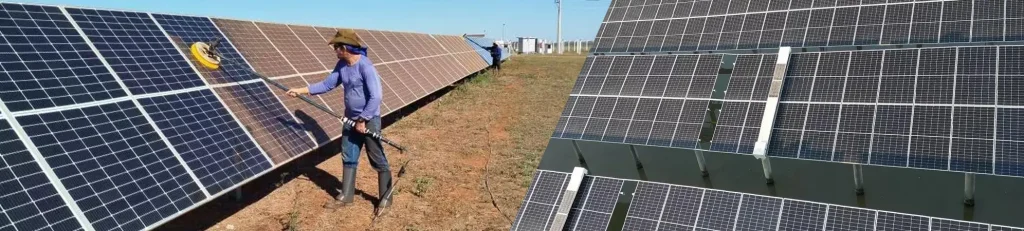
Traditional manual cleaning of solar panels is often criticized as an inefficient “human wave” tactic. Hanging-type PV cleaning robots, however, leverage technology to achieve a qualitative leap in cleaning efficiency.
First, in terms of operational coverage, the robot’s superiority is overwhelming. A single unit can easily clean over 800 square meters in one pass, with a cleaning speed of up to 1000 m²/hour. This is more than twice the efficiency of a three-person manual team, which typically averages around 200 m²/hour. In large-scale centralized power plants, such as those in desert regions, a single robot can clean 1.5-2 megawatts (MW) per day, equivalent to the full workload of 20 skilled workers over 8 hours.
Second, the core driver of this high efficiency is the robot’s intelligent path planning algorithm. It can autonomously identify and avoid shaded areas and obstacles, optimizing its route to reduce invalid movement by approximately 30%. In stark contrast, manual cleaning, lacking precise planning, often results in over 40% of work time wasted on repetitive or missed paths. This transition from “crude coverage” to “precision operation” is the foundation of the robot’s efficiency revolution.
II. The Cornerstone of Safety: Eradicating High-Altitude Work Risks
Safety is a non-negotiable bottom line in PV O&M, and hanging-type robots are a key technology for building this safety barrier. Traditional manual cleaning, whether involving climbing on roofs or using suspended baskets, exposes workers to high-risk environments with dangers of falls, electric shock, and heatstroke. Industry statistics show an average annual accident rate as high as 0.3% to 0.7%.
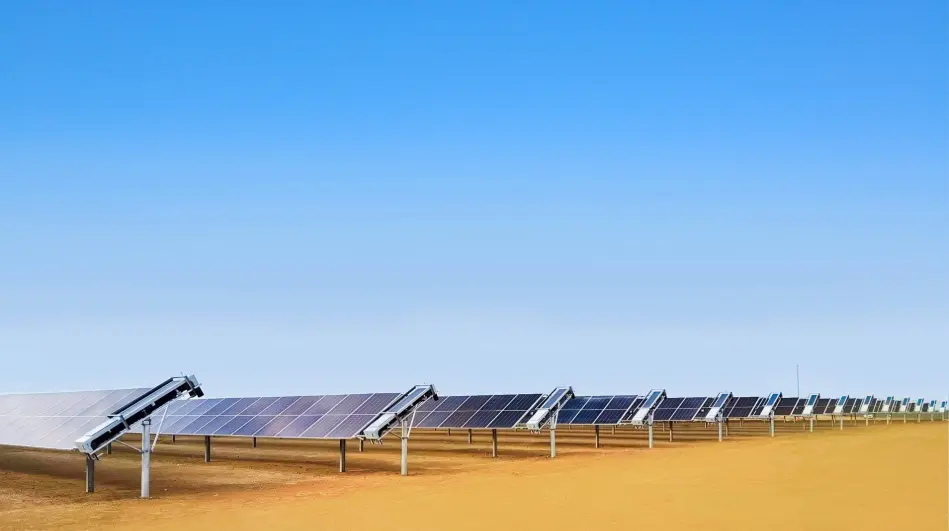
Hanging-type robots fundamentally eliminate high-altitude work risks through their unique operational method. The robot operates directly on the surface of the PV array, using technologies like ultrasonic anti-fall sensors and vacuum suction systems to ensure stable and safe movement, even on slopes up to ±30 degrees. Furthermore, their bodies are commonly designed with high protection ratings of IP65 or even IP68, allowing them to operate reliably in extreme weather conditions like sandstorms and heavy rain. In contrast, manual labor efficiency plummets by over 60% or stops entirely in such conditions.
III. Economic Restructuring: Achieving an Optimal Total Cost of Ownership (TCO)
From a Total Cost of Ownership (TCO) perspective, the economic advantages of hanging-type cleaning robots are exceptionally significant. Despite an initial investment, the Return on Investment (ROI) period is highly attractive, typically ranging from 1.2 to 24 months. For a 10 MW distributed power plant with an annual manual cleaning cost of €20,000, for instance, a robot’s investment can be recouped in just about 1.2 years.
In the long run, the operational cost benefits are even more pronounced. Robots can self-charge using the PV modules’ own power and employ waterless or micro-water cleaning technologies, reducing energy and water consumption per square meter to just 1/5 of traditional manual washing. More importantly, the regular, high-frequency automated cleaning provided by robots can significantly boost a plant’s power generation efficiency by 5% to 30% (averaging around 7.5% to 15%).
For a 100 MW power plant, this translates to annual manual cleaning costs of approximately €250,000, whereas a robotic solution can reduce this to €140,000. Simultaneously, the increased revenue from higher power generation can add an extra €300,000 to €400,000 annually. This demonstrates that robots are not merely a “cost-cutting” tool but a core asset for “efficiency-boosting.”
IV. Unmatched Technical Adaptability: Conquering Complex Scenarios
Faced with diverse and challenging installation environments, hanging-type robots exhibit adaptability far superior to manual labor.
- Extreme Climate Adaptability: Leading products, such as the Luyu hanging PV cleaning robot, feature IP68 full-enclosure protection, wide-temperature-resistant materials (operating from -40°C to 70°C), and mechanical wind-resistant locks, making them ideal for harsh environments like deserts and gobis.
- Solving the Waterless Challenge: In arid and water-scarce regions, the robot’s waterless dry-cleaning technology (using high-speed rotating brushes to physically remove dust) becomes the only viable solution, completely eliminating reliance on precious water resources.
- Compatibility with Complex Scenarios: For non-standard projects such as BIPV (Building-Integrated Photovoltaics), custom-shaped tiles, and fishery-solar hybrid plants, the robot’s modular design allows for quick changes of brushes and adapters. This effectively prevents issues like micro-cracks (with a manual damage rate of ~0.8%) or structural damage caused by foot traffic during manual cleaning.
V. The Intelligent Ecosystem: Paving the Way for Unmanned O&M
A hanging-type cleaning robot is not just an isolated piece of hardware; it is a critical node in the future intelligent O&M network.
- Intelligent Management: O&M personnel can perform remote monitoring, task scheduling, status checks, and firmware over-the-air (FOTA) updates via 4G/5G networks and mobile apps. Advanced features like break-point resume, self-diagnostics, and self-cleaning brushes further minimize the need for human intervention.
- “Air-to-Ground” Collaborative Operation: Robots can seamlessly integrate with drone inspection systems. Drones equipped with thermal cameras quickly scan the power plant to identify and pinpoint faults like hot spots, bird droppings, or stains. The robot then receives instructions to perform targeted spot-cleaning or intensive cleaning in specific areas, creating a highly efficient “intelligent detection – precise response” operational loop.
- Data-Driven “On-Demand Cleaning”: This represents the ultimate form of smart O&M. By integrating dust sensors and combining weather forecast data with historical generation analysis, the system can intelligently decide the optimal time and frequency for cleaning. This is projected to reduce ineffective cleaning cycles by 37%, achieving optimal resource allocation.
Conclusion
In summary, with its core advantages across five dimensions—efficiency multiplication, risk elimination, cost restructuring, all-scenario adaptability, and intelligent ecosystem integration—the hanging-type photovoltaic cleaning robot has comprehensively surpassed traditional manual cleaning methods. It is not only a powerful tool for improving a plant’s ROI but also a cornerstone technology for ensuring PV asset security and propelling the industry toward a truly “unmanned O&M” era. As market penetration increases and “Cleaning as a Service” (CaaS) models mature, these robots are rapidly transitioning from an “optional accessory” to an indispensable “standard configuration” for PV power plants.


