
Dans le monde en pleine expansion des énergies renouvelables, Systèmes de stockage d'énergie par batterie (BESS) deviennent essentiels pour stabiliser les réseaux, alimenter les véhicules électriques et soutenir les solutions d'énergie durable. Mais derrière chaque BESS efficace se cache un processus de production sophistiqué : la chaîne de montage des BESS. Si vous travaillez dans le secteur de l'énergie ou de la fabrication, ou si vous cherchez à investir dans une technologie de stockage, comprendre ce qu'est une ligne d'assemblage BESS et comment choisir la meilleure peut faire toute la différence en termes d'efficacité, de coût et de conformité.
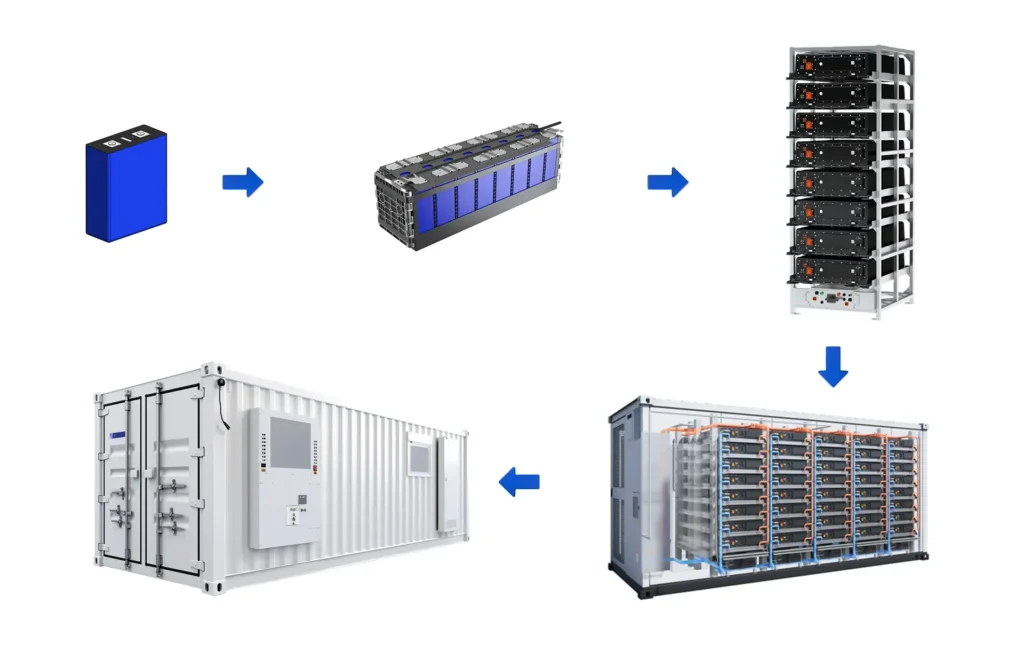
Qu'est-ce qu'une ligne d'assemblage BESS ?
A Ligne d'assemblage BESS (Battery Energy Storage System Assembly Line) est un système de production spécialisé conçu pour fabriquer et assembler des systèmes de stockage en batterie. Ces lignes intègrent divers composants - cellules de batterie, modules, systèmes de gestion de la batterie (BMS), unités de gestion thermique et systèmes de conversion d'énergie (PCS) - en une unité BESS complète et fonctionnelle. L'objectif ? Garantir une production sûre, fiable et évolutive qui réponde aux normes industrielles telles que les certifications IEC, UL et ISO.
Pourquoi les chaînes de montage de BESS sont importantes dans le paysage énergétique actuel
Avec l'évolution mondiale vers l'énergie propre, la demande de BESS monte en flèche. Selon les rapports de marché, le marché des BESS devrait atteindre $20 milliards d'euros d'ici 2027, grâce à des applications dans le domaine du stockage en réseau, de l'énergie solaire résidentielle et de la sauvegarde industrielle. Une chaîne de montage bien conçue permet non seulement d'améliorer l'efficacité de la production, mais aussi de minimiser les défauts, d'assurer la traçabilité et de respecter les règles de sécurité, ce qui est essentiel pour éviter les rappels ou les problèmes juridiques.
Les principaux composants d'une ligne d'assemblage BESS typique sont les suivants :
- Systèmes de manutention: Pour l'alimentation automatique des cellules et des modules.
- Stations d'assemblage: Points d'intégration mécanique et électrique.
- Matériel d'essai: Pour les contrôles de fin de ligne (EOL) de la tension, de la capacité et de la sécurité.
- Outils de gestion des données: MES (Manufacturing Execution Systems) pour le suivi en temps réel et le contrôle de la qualité.
En rationalisant ces éléments, les lignes d'assemblage de BESS atteignent un débit élevé, souvent mesuré en kWh/an, tout en maintenant des performances constantes.
Les processus fondamentaux d'une ligne d'assemblage de BESS
La production de BESS est généralement divisée en deux segments principaux : le Segment du module (axé sur l'assemblage des cellules en modules) et la Segment PACK (intégration des modules dans les batteries finales). Ci-dessous, nous décomposons un flux de travail standard, en mettant en évidence les stations automatisées (surlignées en jaune dans les aides visuelles) et manuelles (surlignées en bleu clair) pour plus de clarté. Cette structure garantit la flexibilité, l'évolutivité et le respect des protocoles de sécurité.
Module Segment Workflow
Ce segment transforme des éléments de batterie individuels en modules fonctionnels. L'automatisation est essentielle ici pour gérer les tâches de précision telles que les essais et le soudage.
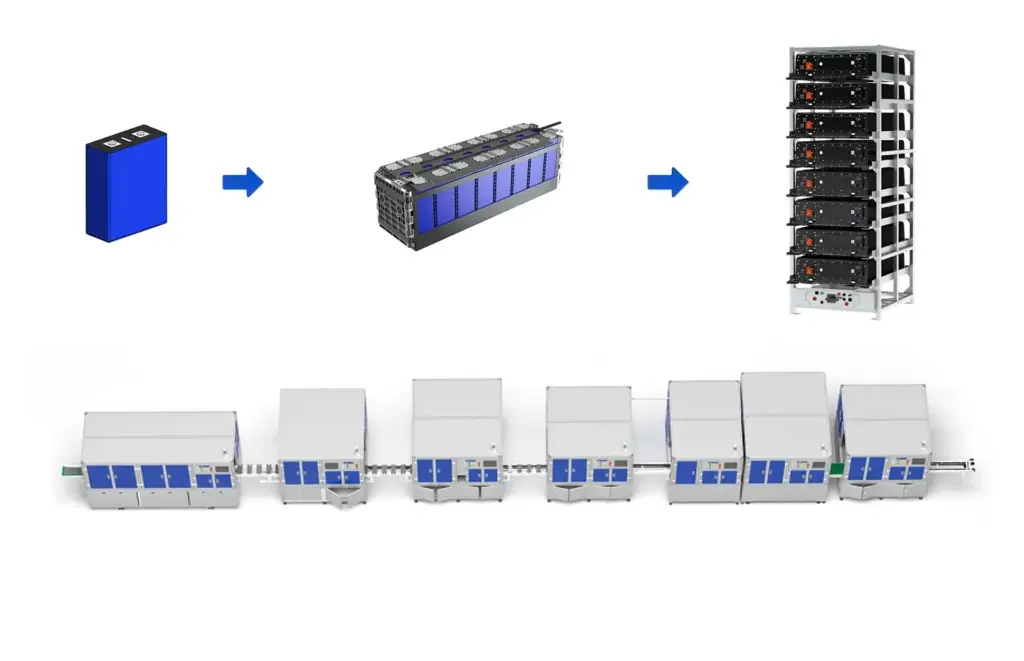
- Chargement des cellules (automatisé): Les cellules sont introduites automatiquement sur la ligne. L'équipement comprend des robots d'alimentation et des scanners initiaux pour les contrôles de qualité.
- Balayage cellulaire / Test OCV / Grouping Flip (Automatisé): Scanne les codes-barres, teste la tension en circuit ouvert (OCV) et retourne les cellules pour les regrouper. Des capteurs de haute précision garantissent que seules les cellules viables sont traitées.
- Application et transfert d'adhésifs cellulaires (automatisé): Applique l'adhésif avec précision et transfère les cellules à la station suivante. Cette étape renforce l'intégrité structurelle.
- Chargement d'empilage de cellules (automatisé): Empile les cellules en modules à l'aide de bras robotisés pour une superposition uniforme.
- Application manuelle de bandes d'acier (manuelle): Les ouvriers appliquent des bandes d'acier protectrices pour sécuriser la pile, ce qui permet une surveillance humaine des formes complexes.
- Positionnement des poteaux / Nettoyage (automatisé): Localise et nettoie les poteaux d'électrodes et prépare les connexions.
- Manuel d'installation des composants CCS (manuel): Installe les composants du système de connexion cellulaire (CCS), en veillant à ce que la dextérité manuelle garantisse un ajustement correct.
- Soudage au laser de plaques de harnais CCS (automatisé): Utilise des lasers pour le soudage précis des plaques de harnais, ce qui garantit la fiabilité électrique.
- Module Réinspection manuelle et nettoyage (manuel): Contrôles visuels et nettoyage pour détecter rapidement les défauts.
- Ligne d'échantillonnage Soudage manuel (manuel): Soude des lignes d'échantillonnage pour la surveillance (par exemple, des capteurs de température).
- Test de fin de vie des modules (automatisé): Tests complets de fonctionnalité, avec enregistrement des données pour la traçabilité.
- Test de la ligne d'échantillonnage (réservé, manuel): Vérification manuelle en option pour les besoins spécifiques.
- Déchargement ou mise en boîte du module (manuel): Prépare les modules pour le segment ou le stockage suivant.
Workflow du segment PACK
Cette phase consiste à assembler les modules en batteries complètes, en mettant l'accent sur l'intégration des boîtiers et des systèmes. Les stations manuelles sont fréquentes ici en raison des besoins de personnalisation.
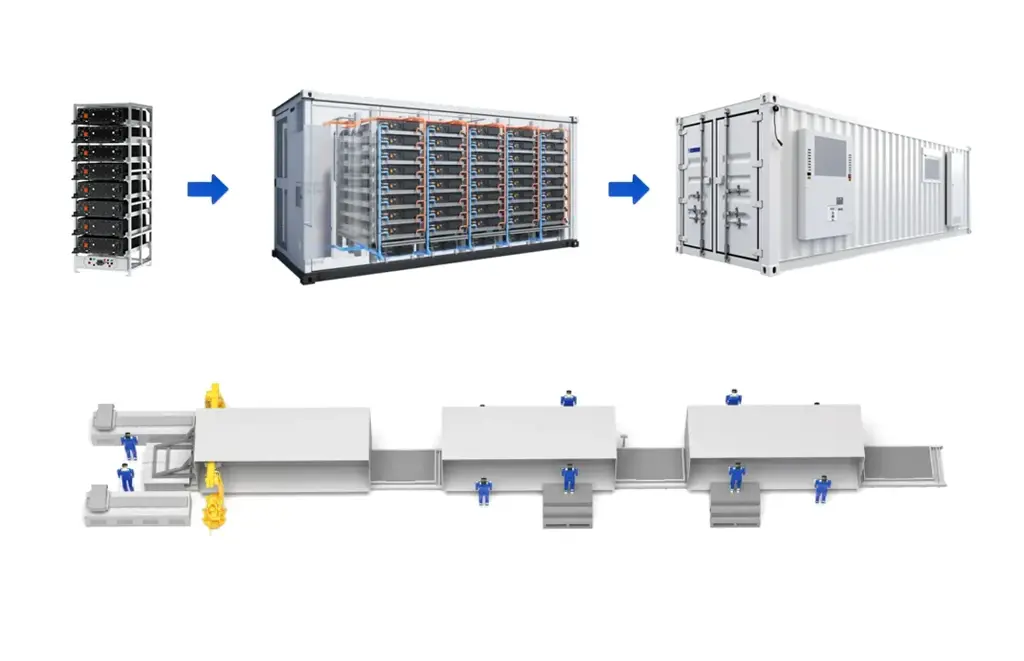
- Chargement de l'enceinte et test d'étanchéité à l'air (manuel): Charge le boîtier de la batterie et vérifie l'absence de fuites.
- Pré-installation des composants du boîtier (manuel): Ajoute des pièces préliminaires telles que des supports.
- Application de l'adhésif sur le fond de l'enceinte (automatisé): Application robotisée du produit d'étanchéité pour une couverture homogène.
- Insertion du module dans le boîtier (manuel): Place les modules en toute sécurité à l'intérieur.
- Fixation du module (manuelle): Fixe les modules à l'aide de boulons, ce qui garantit la résistance aux vibrations.
- Installation des jeux de barres en cuivre / fusibles (manuel): S'adapte aux connecteurs électriques et aux fusibles.
- Installation de la barre de connexion / du harnais (manuel): Achemine le câblage pour une connectivité optimale.
- BMS / Installation principale positive/négative (manuelle): Intègre le BMS et les terminaux.
- PACK EOL Testing (manuel): Contrôles finaux des performances de l'ensemble de la meute.
- Installation du couvercle du boîtier (manuel): Scelle l'emballage avec le couvercle.
- Test d'étanchéité à l'air d'une enceinte complète (manuel): Vérifie l'étanchéité de l'ensemble.
- Déchargement du PACK (manuel): Préparer l'emballage fini pour l'expédition ou l'assemblage ultérieur.
Ces flux de travail peuvent être personnalisés en fonction de la composition chimique des batteries, comme le LFP (Lithium Fer Phosphate) ou le NMC (Nickel Manganèse Cobalt), avec des niveaux d'automatisation ajustés en fonction de l'échelle de production.
Comment choisir la bonne ligne d'assemblage BESS
Le choix d'une ligne d'assemblage BESS implique de trouver un équilibre entre la capacité, le coût et la conformité. Voici un guide étape par étape pour prendre une décision éclairée.
Facteurs clés influençant votre choix
- Capacité et évolutivité: Visez des lignes correspondant à votre objectif de production (par exemple, 2 à 5 MWh/an). Les conceptions modulaires permettent une expansion facile.
- Compatibilité chimique des batteries: Assurez-vous que la ligne gère le type que vous préférez (par exemple, LFP pour la sécurité, NMC pour la densité).
- Niveau d'automatisation: Un degré élevé d'automatisation réduit les coûts de main-d'œuvre mais augmente l'investissement initial. Les lignes hybrides (mélange d'automatique et de manuel) offrent une certaine flexibilité.
- Espace et infrastructures: Tenir compte de l'encombrement de l'usine, de l'alimentation électrique et des besoins de ventilation.
- Données et traçabilité: Les systèmes MES/ERP intégrés pour les données en temps réel ne sont pas négociables pour l'assurance qualité.
- Sécurité et conformité: Recherchez des certifications telles que UL 9540 et des caractéristiques telles que la suppression des incendies.
- Coût et retour sur investissement: Calculer le coût total de possession (TCO), y compris les dépenses d'investissement, les dépenses d'exploitation et la période de récupération.
Processus de sélection étape par étape
- Définir les besoins: Préciser la capacité, la chimie, le budget et le calendrier.
- Options de recherche: Comparez les lignes automatiques, semi-automatiques ou en phase.
- Évaluer les mesures: Vérifier le débit, les taux de rendement, la consommation d'énergie et le MTBF (temps moyen entre les défaillances).
- Comparer les fournisseurs: Examiner les études de cas, l'assistance après-vente et les délais de livraison.
- Effectuer une évaluation des risques: Essais pilotes pour valider les processus.
- Analyse des coûts: Utiliser des calculateurs de retour sur investissement pour prévoir les rendements.
- Mise en œuvre du plan: Décrire l'installation, la formation et les étapes.
Liste de contrôle pour la sélection des lignes d'assemblage BESS
- Capacité: Sortie cible, modules d'expansion.
- Adaptation du processus: Compatibilité avec votre flux de travail (par exemple, capacités de soudage au laser).
- Automatisation: Ratio des stations automatiques/manuelles, types de robots.
- Fiabilité: MTBF, contrôles de qualité.
- Intégration: Systèmes de données, interfaces BMS.
- Sécurité: Certifications, protocoles d'urgence.
- Coûts: Investissement initial, entretien, pièces détachées.
- Risques: Délai de livraison, stabilité de la chaîne d'approvisionnement.
Pour les aides visuelles, envisagez des diagrammes de flux de travail ou des tableaux de comparaison - des outils comme Canva peuvent vous aider à les créer pour votre site.
Conclusion : Construire une chaîne de montage de BESS à l'épreuve du temps
Une ligne d'assemblage de BESS est plus qu'une simple machine, c'est l'épine dorsale d'une production de stockage d'énergie efficace et sûre. En comprenant les processus modulaires et PACK et en suivant une approche de sélection structurée, vous pouvez investir dans un système qui évolue avec votre entreprise. N'oubliez pas que le bon choix minimise les risques, maximise le retour sur investissement et vous positionne à l'avant-garde de la révolution de l'énergie verte.
Prêt à commencer ? Contactez-nous pour une consultation personnalisée sur la ligne d'assemblage BESS, ou téléchargez notre modèle de sélection gratuit. Faites-nous part de vos réflexions dans les commentaires : quel est votre plus grand défi en matière de fabrication de BESS ? Pour en savoir plus sur la production de batteries, consultez nos guides sur l'intégration des BMS et le stockage durable de l'énergie.
Mots-clés : Ligne d'assemblage BESS, production de systèmes de stockage d'énergie en batterie, processus de fabrication BESS, sélection d'une ligne d'assemblage BESS, assemblage de modules de batterie, flux de travail pour l'assemblage PACK.